
From the The Bright Side: Meet people making a difference in our community series
by Peter Breen
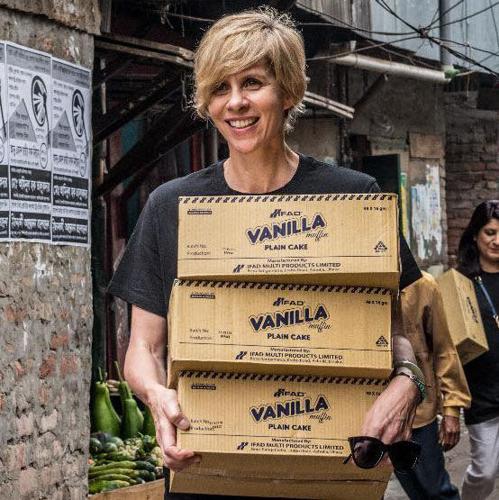
Lincoln native Priscilla Heffelfinger’s childhood grumblings weren’t met with much sympathy from her mother.
Heffelfinger’s mom grew up in the village of Davey but moved to Lincoln after her family “lost the farm” and was so poor that she had to resort to eating ketchup sandwiches.
“She really raised all six of her kids — my three brothers and my two sisters — to give back,” Heffelfinger said. “If I ever complained about anything, she had me out doing soup kitchens. There was an immediate response: You’re going to see a world outside of your world.”
Life took Heffelfinger away from the state after college at the University of Nebraska-Lincoln, but she said she has taken her Nebraska values with her.
Those values inspired Heffelfinger to found a nonprofit that feeds children in Southeast Asia, work for which she was recognized last month when named to Inc. magazine’s annual Female Founders 500 list. Today she lives in California.
Heffelfinger moved to Bangladesh in 2012 for her husband’s work with the Centers for Disease Control and Prevention. They had four children, between the ages of 7 and 13.
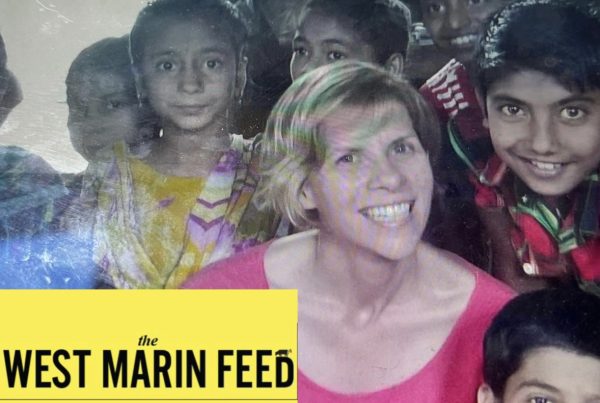
Overwhelmed by the poverty confronting children in Bangladesh, who would knock on the windows of her car and put their hands up to their mouths begging for food, Heffelfinger founded the nonprofit Thrive with two other women.
Thrive started by feeding kids at one school in the Korail slum of Dhaka and now serves more than 3,000 meals a day at 13 schools in Bangladesh and four schools in the Philippines.
Heffelfinger said she sees the impact of Thrive in school attendance statistics and in success stories, like one student who won gold in a national swim competition in the Philippines after Thrive volunteers took him to a swim meet and gave him goggles.
Growing up on a remote island, the kid had swum his whole life.
Heffelfinger said after Thrive starts serving meals at a school, enrollment generally increases between 10% and 20% and attendance rates shoot up. Thrive schools on average have attendance rates 15 to 17% higher than peer schools.
“We see kids graduating high school who would not have normally entered kindergarten,” said Gina Gabel, one of Thrive’s co-founders.
Though a world apart in climate and some customs, Nebraska and Southeast Asia share an attitude, said Heffelfinger, using an old “The Far Side” cartoon depicting a Nebraskan with an arrow going through his head to illustrate her point.
In the cartoon, the guy with the arrow in his head is asked about how he’s doing, and the guy downplays the arrow and says he’s “fine,” Heffelfinger said.
“We’re wired to just do it,” Heffelfinger said. “Being in Bangladesh had a similar feel to Nebraska but about 100 times more people, or maybe 1,000 times more people with that same attitude: We’re going to do this. We’re going to do this together.”
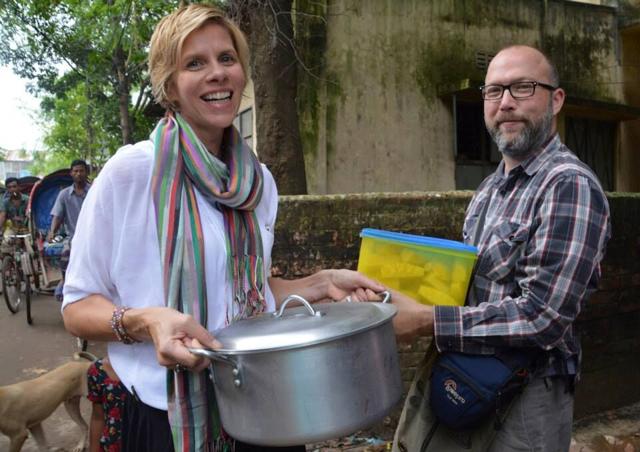
Heffelfinger said she inherited her can-do attitude from her family, but she thinks the attitude is widespread in Nebraska and the Midwest and permeates the globe.
But she added that when she’s lived in the U.S. outside the Midwest, and that attitude, which she thinks comes from a farming background, isn’t as visible.
There are even some similarities between a beef-filled Runza and shingara, a fried Bangladeshi pie made with pastry dough and stuffed with spiced potatoes, peas or mincemeat.
Heffelfinger said because it’s so hot, the tropical fruit in Southeast Asia is to die for and the vegetables are good too.
“I remember specifically when we started serving carrots in the Philippines,” Heffelfinger said. “They never had a raw carrot. They’ve only had a cooked carrot, and very rarely did they have that. At first, they didn’t really know how to eat it.”
Gabel, an American in Dhaka when Thrive was founded in 2012 because her husband worked at the U.S. Embassy, said she met Heffelfinger while on a one-off mission inspired by someone at the embassy to deliver peanut butter and jelly sandwiches to a school that would become Thrive’s first school.
Heffelfinger said Thrive expanded to schools in the Philippines after she and her family moved there in 2015.
A unique addition to Thrive’s Philippines operation is that the mothers of the kids fed at school are paid to cook the meals, Heffelfinger said.
Though Thrive’s average school is about 200 kids, its largest is almost 700 and the smallest is a school of 23 for Indigenous children in the Philippines.
“One thing Thrive does that’s different from other organizations is when we start with a school, we stay with a school because we know the next group of kids are coming,” Heffelfinger said. “You may have fed that kindergarten, but that kindergarten (class) is going to go on to first grade, etc., etc. We spend a lot of time picking the school we’re going to support.”
Back in Nebraska, Heffelfinger’s nephew Griffin Perry, an accountant by day living in Ashland, volunteers for Thrive serving as its treasurer.
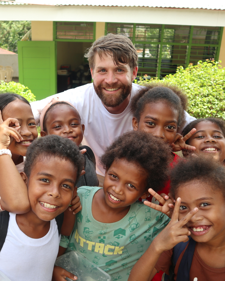 Perry is hoping to visit Bangladesh for the first time in 2027 but was able to sneak in a quick trip to the Philippines in October.
He said one of the best parts was getting to know the team on the ground that sets up Thrive’s program and does fundraising. There are people, due to distance, that Perry must usually resort to keeping in contact with through email.
“They’re a lot more professional in their tone than some of my day-to-day conversations,” Perry said. “I think that’s just how they’re trained to work with international companies, and it’s just weird when you’re used to being very low-key to have some of those formal emails come through. I’m not used to that — someone being so polite and kind.”
Article first featured on Lincoln Journal Star on April 25, 2026.